
Strength Notes with Coach Vincent (February 2026)

Coach Vincent has something to say about strength training and it involves a dice…check it out…
Let the Die Decide Your Fate
As many of my students know, I’m a fan of using dice to help design training sessions.
One student once joked that it “gamifies” training. That’s not wrong. It keeps sessions fresh and engaging while still practicing the same fundamental skills week after week.
At first glance, letting a die determine aspects of your training might seem lazy or ineffective. In reality, it’s grounded in three principles long identified by Russian sports scientists:
Continuity of the training process
Load optimization
Load waviness
This is not randomness. It’s structured variability.
Continuity of the Training Process
Continuity means practicing the same fundamental exercises over time
When progress stalls, many lifters switch exercises, programs, or systems. Something new creates the illusion of progress—especially early on. New movements feel productive. You get sore. It feels like something is happening.
But novelty is often the easy way out.
Starting over doesn’t solve the problem of adaptation—it avoids it.
Rolling the die allows us to practice the same skills in slightly different ways. Just enough variation to keep attention high, without abandoning the work that actually produces results.
Same, but different.
Load Optimization
All effective programs manipulate three variables:
Intensity — how heavy, how fast, how close to failure
Volume — total reps and total load
Density — how much work gets done in a given time
Progress requires doing enough work to force adaptation, but not so much that you break in the process.
Over the long term, you must increase volume, intensity, density—or some combination of the three—without burning out.
If every session demands more weight, more reps, and more effort than the last, you’re not building. You’re peaking. Or stalling. Rolling the die helps regulate this automatically.
Load Waviness
Adaptation is cyclical. It doesn’t move in straight lines.
There are peaks and valleys. Easier days and harder days. Periods of accumulation followed by periods of recovery. This is not a flaw— it’s a feature. It’s how complex systems work.
We don’t control this reality. We respect it.
Letting the die guide session demands introduces natural fluctuations in intensity, volume, and density. It mirrors real life and protects long-term progress better than rigid, linear plans.
This approach almost guarantees occasional overreaching.
That’s not a problem—provided it’s followed by intentional reduction in training stress. When managed correctly, this pattern produces excellent gains in strength and conditioning.
There’s a Lithuanian saying:
A river with a dam has more power.
What Sessions Actually Look Like
This style of training produces a wide range of sessions:
Medium / Medium — the foundation; these sessions build more than they take
High / High — tests of strength and resolve, best followed by a taper
Low / Low — technique work and active recovery
Low / High — opportunities to set personal records
High / Low — base-building work that supports future gains
Some days feel strange. That’s expected. Over time, it works.
Letting the die decide your fate isn’t a lazy coaching tactic. It’s a simple, proven way to respect continuity, optimize load, and work with—rather than against—the natural waves of adaptation.
It works with Simple & Sinister, Quick and the Dead, Easy Strength, All-Terrain Conditioning, and so many more programs.
If you’d rather not guess, I offer in-person coaching to handle the structure so you can focus on the work—and the rest of your life.
Yours in Strength,
Vincent Southard
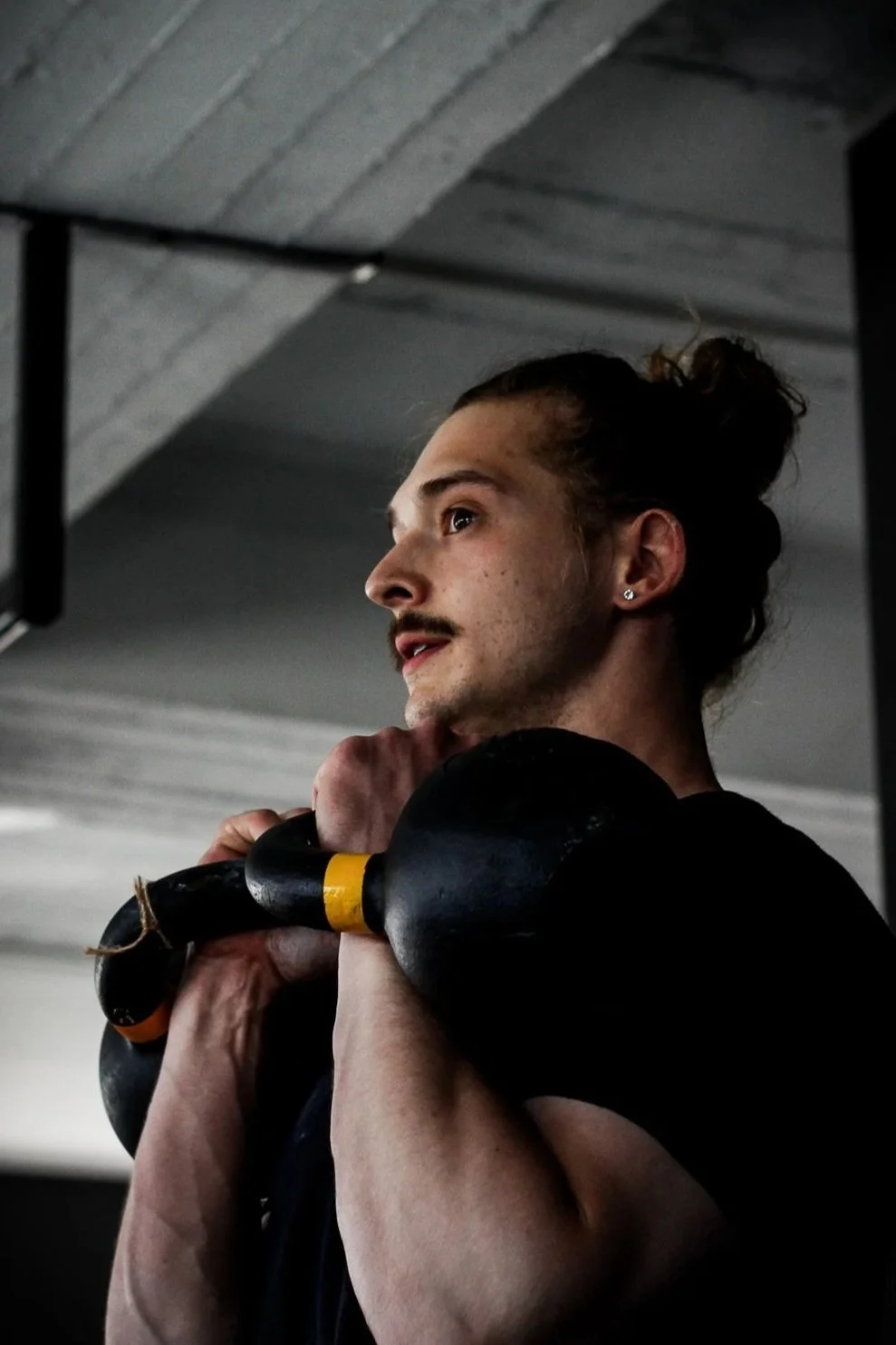
Vincent Southard
Vincent is a Seattle native whose passion for fitness began when he first picked up a barbell at 14. Since joining FUELhouse in 2022, he’s loved building community through coaching and helping others grow stronger and more confident.
Outside the gym, you’ll find him experimenting with healthy meal prep, walking the Burke-Gilman (often barefoot), or reading and learning as a lifelong student of strength.